DiveVuse, Canemox, LenWatis or AquaLens Pro? 5 Underwater Fishing Camera Names, Side by Side
Short answer. On November 16, 2026, the listings of these four names called each one an underwater fishing camera. We have not tested these four names; what matters is cable length, light at the lens and battery life in the cold.
You want a live look under your boat or ice hole before you drop a line. If you have seen names like DiveVuse and Canemox in ads, the choice is which camera fits your trips. That comes down to the depths you fish, the cold you sit in, and how dim the water gets.
The names side by side
Each row gives a name, its seller and the type its listing gave on November 16, 2026. If your trip has a set date, weigh each seller's stated delivery against it. If unsure, read each seller's returns and contact pages first.
| Name | Seller | Product type as listed | Listing read |
|---|---|---|---|
| DiveVuse | Another seller | “Underwater Fishing Camera” | Nov 16, 2026, cited as text |
| Canemox | Another seller | “Underwater Fishing Camera” | Nov 16, 2026, cited as text |
| LenWatis | Another seller | “Underwater Fishing Camera” | Nov 16, 2026, cited as text |
| Aquafisx | Another seller | “Fishing Underwater Camera” | Nov 16, 2026, cited as text |
| Sold by KesslundAquaLens Pro | Kesslund | Underwater fishing camera on a 49 or 98 ft cable reel, with infrared lights and a 4.3-inch screen | AquaLens Pro product page |
Other sellers' listings as they stood on November 16, 2026, in no particular order, cited as text without a link. Sources: the DiveVuse listing on astrasave.com, November 16, 2026; the Canemox listing on lusamax.com, November 16, 2026; the LenWatis listing on dealsaving.store, November 16, 2026; the Aquafisx listing on dealsaving.store, November 16, 2026.
How to choose underwater fishing cameras
How deep you fish
Cable length is the first trade-off. If you fish shallow bays or a weed line, a short cable is less to carry and less to wind back. If you sit over deep holes on the ice or drift over a channel, you want cable that reaches past your usual depth.
If a page gives cable in meters, convert it: a meter is a little over three feet. Then hold the number up against your depth chart. Pick for the water you fish most weeks, not the one deep trip a year.
When in the season you go out
Cold weather drains batteries faster, so your season shapes this choice. If you fish open water in summer, compare the stated run times. If you fish the ice, cold cuts that time short. Look for the temperature range the seller states, and keep the monitor in a coat pocket between looks.
Battery size often shows up as a mAh number. A bigger number holds more charge, but a stated run time tells you more. Also see how the kit charges: if it leaves out a wall adapter, pack one you already own.
How you will watch the screen
A larger screen is easier to read from a bucket seat, but it adds weight to your pack. If you fish open water under bright sun, glare is the trade-off: a sun visor or an anti-glare screen helps. In a dark shanty or at first light, a smaller screen often does the job.
If you want to save clips of a trip, look for stated video recording and the memory card size it takes. If you only want a live look, you can skip that and keep the kit simple.
Looking at underwater fishing cameras? Kesslund sells AquaLens Pro.
Where AquaLens Pro fitsHow dark the water runs
Light at the lens matters at dawn, in deep water and under thick ice. If you fish those hours, read what lights the product page lists: infrared, white LEDs or both. Some kits also let you flip the picture from color to black-and-white.
Murky water is a separate matter. Lights add light; they do not clear silt or stained water. Set your hopes by what the page states, not by the photos in an ad.
How you rig it and carry it
If you fish from a boat or the bank, a float and tie points help the camera hang where you want it. If you sit on the ice all day, a rod holder frees your hands. A case or bag keeps the cable from tangling on the walk in.
Where AquaLens Pro fits
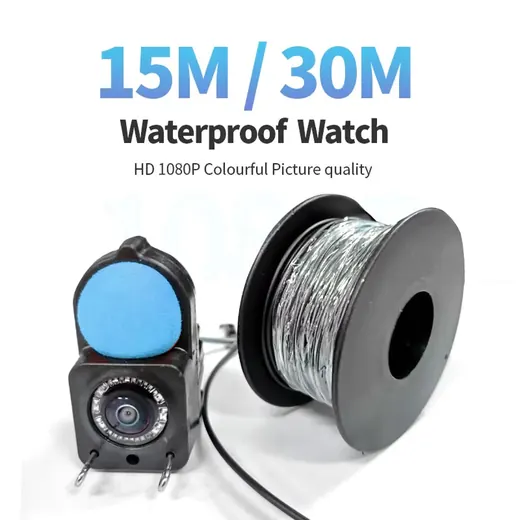
AquaLens Pro suits you if you fish an ice hole or cast from where you stand and want to see the bottom first. It fits early starts and deep water too, since infrared lights brighten the area by the lens when light runs low.
You can watch with your hands free, because a rod holder comes in the kit. You can tie the camera on right at the spot you want to check, since your line runs through two metal eyelets under a foam float. You can look closer near your bait, with zoom and a color or black-and-white switch on one screen.
You can start each cold trip on a full charge, since the built-in battery recharges over USB at home. On dim mornings you can tune the picture to the water, since a monitor switch sets the infrared brightness. After a trip, the cable packs away neatly, because it winds back onto its own reel.
Its product page notes that the box includes a USB charging cable but no wall adapter. Two or three units cost less each on the AquaLens Pro page, if more than one person will use one.
See AquaLens Pro at Kesslund 90-day returns
Common questions
Is DiveVuse legit?
About DiveVuse, we have no yes or no to give. On November 16, 2026, the DiveVuse listing gave the product type as “Underwater Fishing Camera”. Look past the ad to the shop behind it. If it shows an address, a phone number and a return window, you can follow up. If not, think twice.
How do I compare DiveVuse with other underwater fishing cameras?
Compare any two listings by what each kit brings to your trips. If one kit includes a rod holder or wall adapter and the other does not, add what you would still need to buy. If the cable options differ, pick the one that reaches your usual depth. If the return windows differ, the longer one gives you more time to try a kit on the water.
How much cable does an underwater fishing camera need?
You need enough cable to reach the deepest spot on your usual trips, plus a little spare. Some kits come in two lengths, so pick by the water you fish most. For Aquafisx, its product page stated "The camera comes with a 20-meter cable" on July 25, 2026. For DiveVuse, its product page options listed "15M, 30M" on September 30, 2026.
How do cold trips change the choice?
On cold trips, the battery and the stated temperature range come first. Cold drains a charge faster, so a full charge the night before counts. For DiveVuse, its product page stated "Operates In Temperatures From 14°F To 122°F" on November 20, 2026. Compare any stated range with your coldest morning on the ice, and see whether a run time is given.
Does Kesslund sell Canemox?
Kesslund does not sell Canemox. The store's own camera is AquaLens Pro, an underwater fishing camera you lower on a cable below your boat or ice hole. You can watch the water from where you sit, since the box holds a 4.3-inch monitor and the camera on a cable reel. A rod holder and USB charging cable come along, so you only add your own wall adapter.
AquaLens Pro comes from Kesslund, with returns accepted for 90 days.
- Returns
- 90 days from delivery, for a refund
- Contact
- support@kesslund.com, (307) 249-3770
- Delivery
- Ships within 0 to 2 business days, then arrives within 5 to 12 business days, with tracking by email
See AquaLens Pro at Kesslund 90-day returns